Cut resistance explained: EN 388 vs ANSI/ISEA 105
What EN 388 measures
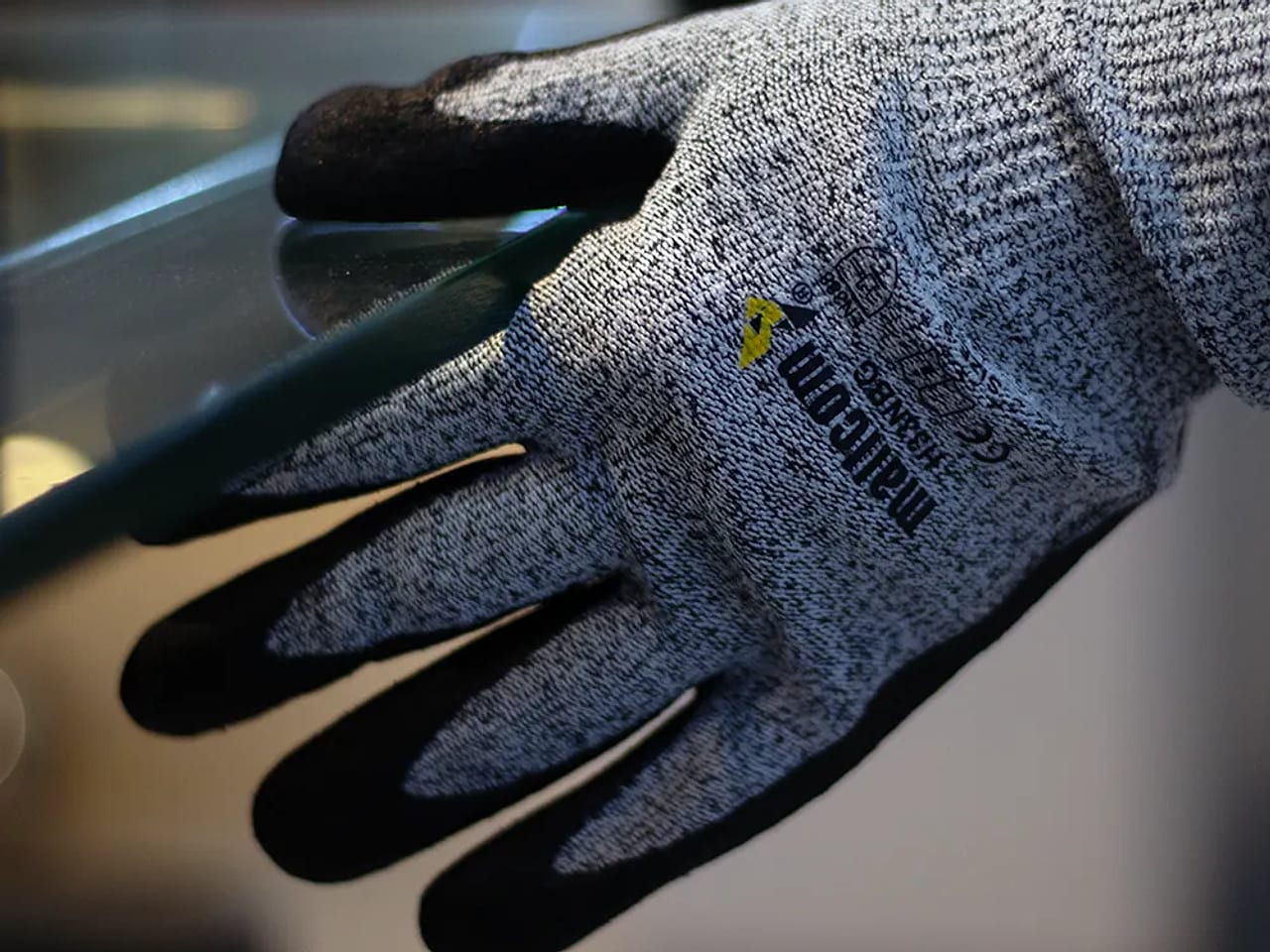
EN 388 is the European standard for gloves protecting against mechanical risks: abrasion, blade cut, tear and puncture, with impact added in 2016. Each glove carries a pictogram with performance levels (1–5 for abrasion, tear and puncture) alongside the cut rating.
The Coup test and why it tops out
The original cut test (the Coup test) drags a rotating circular blade across the sample until it cuts through, scoring 1–5. It is reliable only up to about level 3: on modern high-cut fibres such as steel or glass filament, the blade dulls before cutting, so the result is not meaningful.
The TDM / ISO 13997 test
For materials that dull the Coup blade, EN 388:2016 adds the ISO 13997 straight-blade test, scored A–F. This measures the force in newtons needed to cut the sample in a single pass, so it stays meaningful for the highest-performing gloves.
ANSI/ISEA 105 and the A-levels
The American standard ANSI/ISEA 105 (2016) also uses ISO 13997 and reports A1–A9 levels, making it broadly comparable to EN 388 A–F. A4 is roughly 1,500+ grams of cutting force, A6 about 3,000+, and A9 6,000+ grams.
How to choose a level
Match the level to the hazard, not the highest number on the shelf: light assembly and general handling suits A2–A3, sheet metal and glass handling A4–A6, and high-risk work such as meat processing or heavy steel handling A7–A9. Grip and abrasion resistance matter as much as cut rating — a high-cut glove with poor grip is dangerous on sheet.
Tests conducted: EN 388
How Mallcom tests its products to this standard.
Abrasion
Based on the number of cycles required to abrade through the sample glove (abrasion by sandpaper under a stipulated pressure). The protection factor is then indicated on a scale from 1 to 4 depending on how many revolutions are required to make a hole in the material. The higher the number, the better the glove.
Blade cut
Based on the number of cycles required to cut through the sample at a constant speed. The protection factor is then indicated on a scale from 1 to 5.
Tear
Based on the amount of force required to tear the sample. The protection factor is then indicated on a scale from 1 to 4.
Puncture
Based on the amount of force required to pierce the sample with a standardly sized point. The protection factor is then indicated on a scale from 1 to 4.
TDM blade cut
The glove sample is placed on a conductive strip and loaded onto the TDM-100. When the metal blade touches the metal strip, the test is terminated. A straight blade is loaded into the machine. Weight is added to serve as a force. The blade moves across the fabric. The blade is replaced with a new one to ensure accuracy. The sample is cut five times, each with three different loads. The distance travelled to cause cut through at various forces is recorded. The data is used to determine the load required to cut through the sample.
Impact
In this test, gloves are cut, opened out flat, so that the area of impact protection can be tested independently, and secured over a domed anvil. The test area is impacted with a 2.5kg flat face striker from a sufficient height to provide impact energy of 5J. The peak force – detected by a load cell or sensor mounted beneath the anvil – is recorded.